
Targeted Communications for Airport Operations
Targeted Communications for Airport Operations
Targeted Communications for Airport Operations
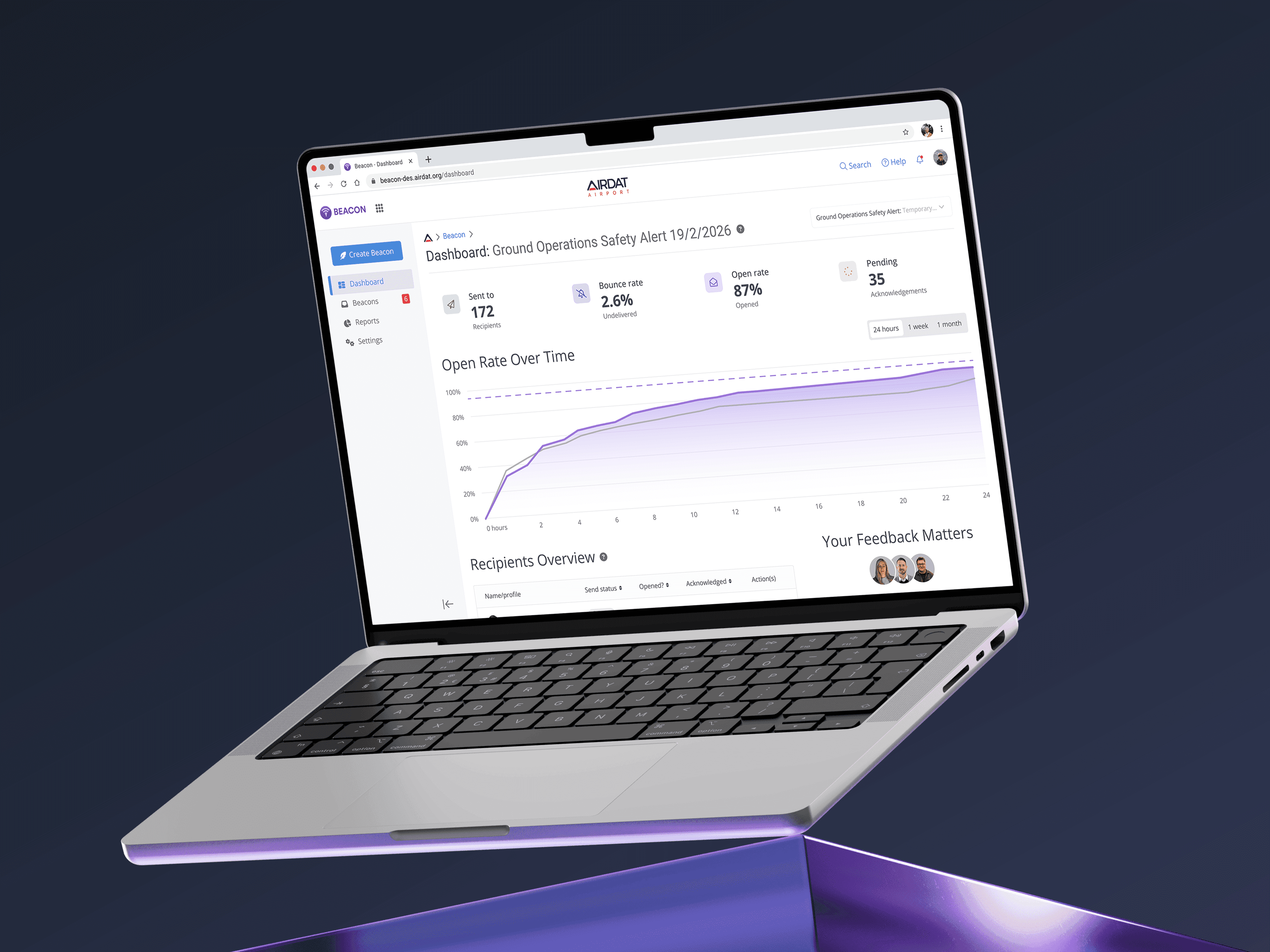
Built to replace blanket broadcasts and paper notices, this airfield communications system enables ops teams to deliver crucial messages to specific people using live staff, company and permissions data, with read tracking and enforced acknowledgement.
Built to replace blanket broadcasts and paper notices, this airfield communications system enables ops teams to deliver crucial messages to specific people using live staff, company and permissions data, with read tracking and enforced acknowledgement.
Built to replace blanket broadcasts and paper notices, this airfield communications system enables ops teams to deliver crucial messages to specific people using live staff, company and permissions data, with read tracking and enforced acknowledgement.
Role
UX Researcher
UI Designer
UI Developer
Tools
Figma
Figjam
WebStorm
Team
Development Team
QA Engineer
Timeline
Sep '25 - Feb '26
Role
UX Researcher
UI Designer
UI Developer
Tools
Figma
Figjam
WebStorm
Team
Development Team
QA Engineer
Timeline
Sep '25 - Feb '26
The problem
Fragmented, Untargeted, and Unaccountable
Existing airport communication methods were untargeted, relying on generic broadcasts or physical noticeboards that couldn’t ensure updates were reaching the right people.
This meant that senior management were constantly tackling the issue of accountability. There was no visibility into who had seen or acknowledged messages, making compliance extremely difficult to enforce.
Information was also fragmented, with operational updates and documents spread across noticeboards, emails, and legacy systems.
The problem
Fragmented, Untargeted, and Unaccountable
Existing airport communication methods were untargeted, relying on generic broadcasts or physical noticeboards that couldn’t ensure updates were reaching the right people.
This meant that senior management were constantly tackling the issue of accountability. There was no visibility into who had seen or acknowledged messages, making compliance extremely difficult to enforce.
Information was also fragmented, with operational updates and documents spread across noticeboards, emails, and legacy systems.
The solution
From Fragmentation to Precision and Accountability
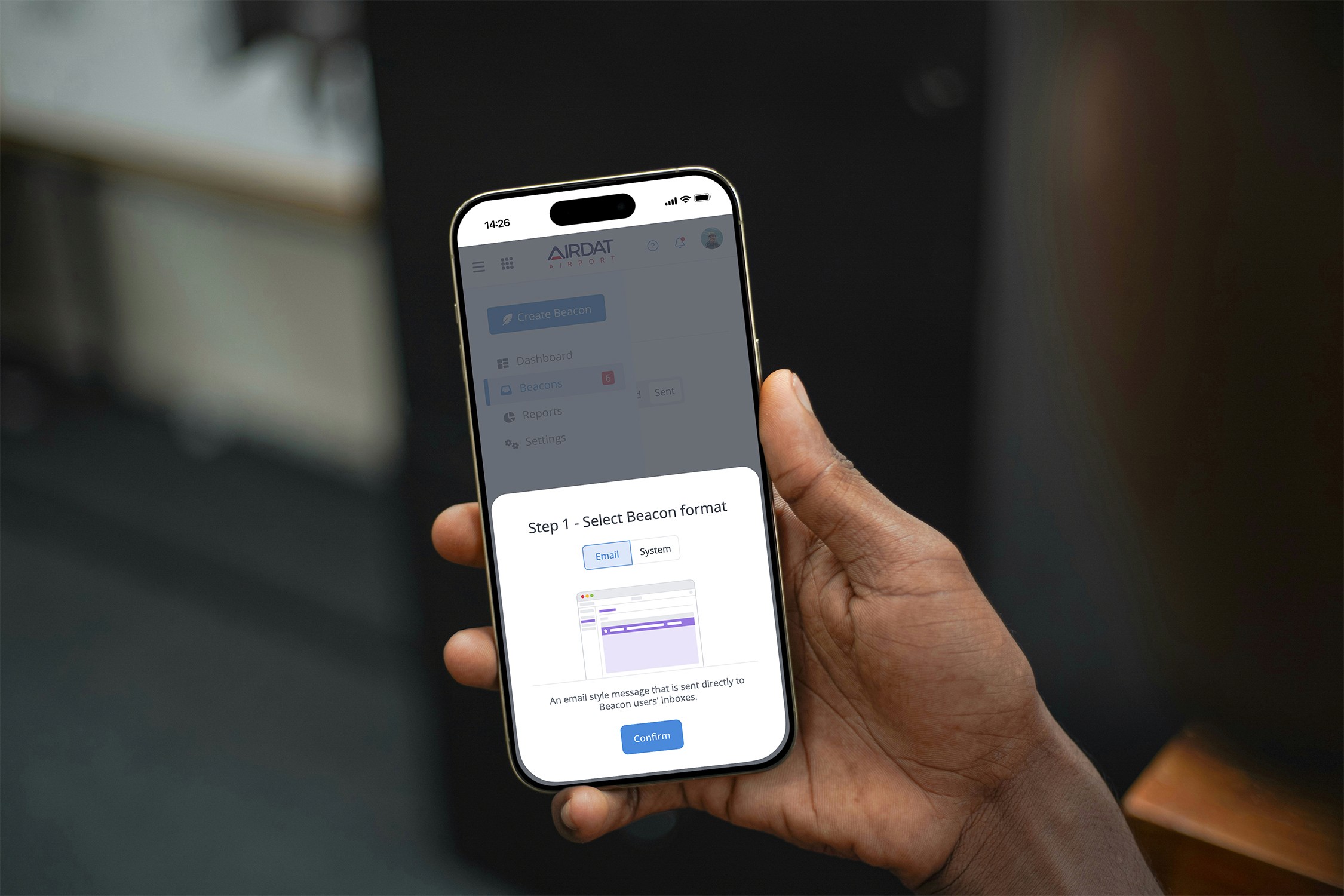
Beacon was designed as a centralised, role-aware communications platform within the AIRDAT suite. By building on a single AIRDAT account and its existing user data, including company, job role, and permissions, Beacon enables airport operations teams to communicate with precision, confidence, and clarity.
Targeted Comms
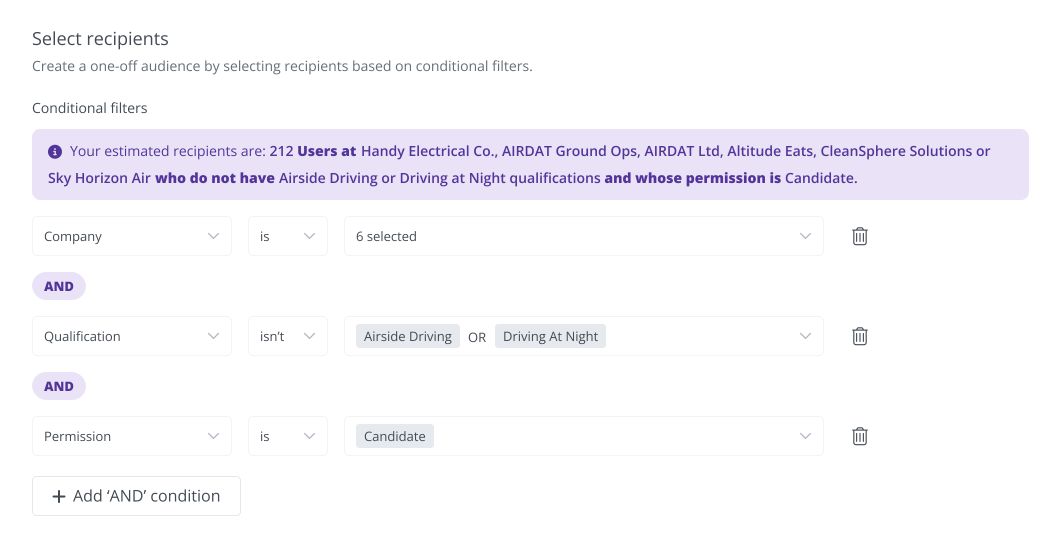
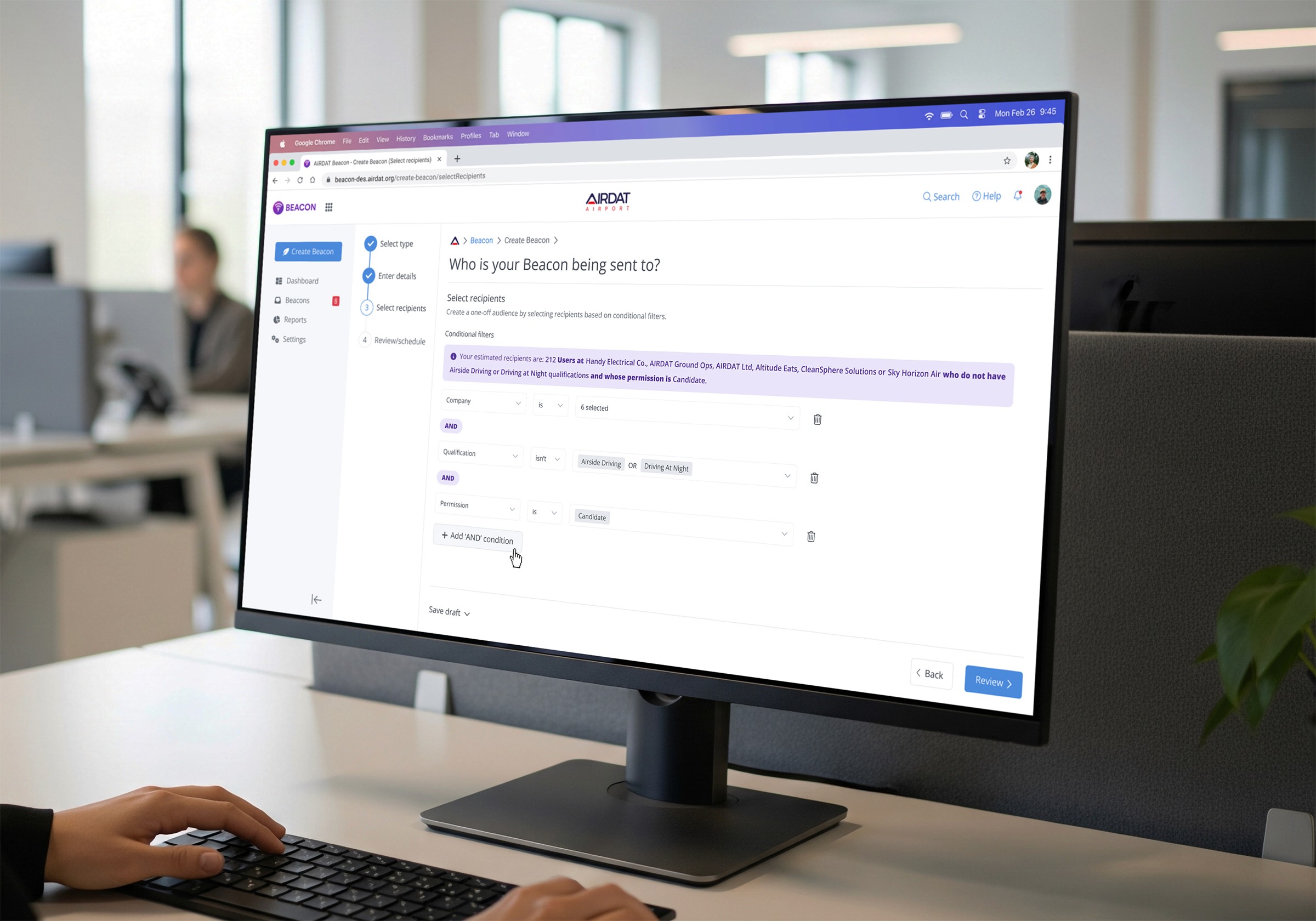
Using live data from AIRDAT, writers can build an audience which targets recipients by company, job role, and permission. This removes ineffective general broadcasts and ensures operational updates reach only the relevant people.
Accountability and Visibility
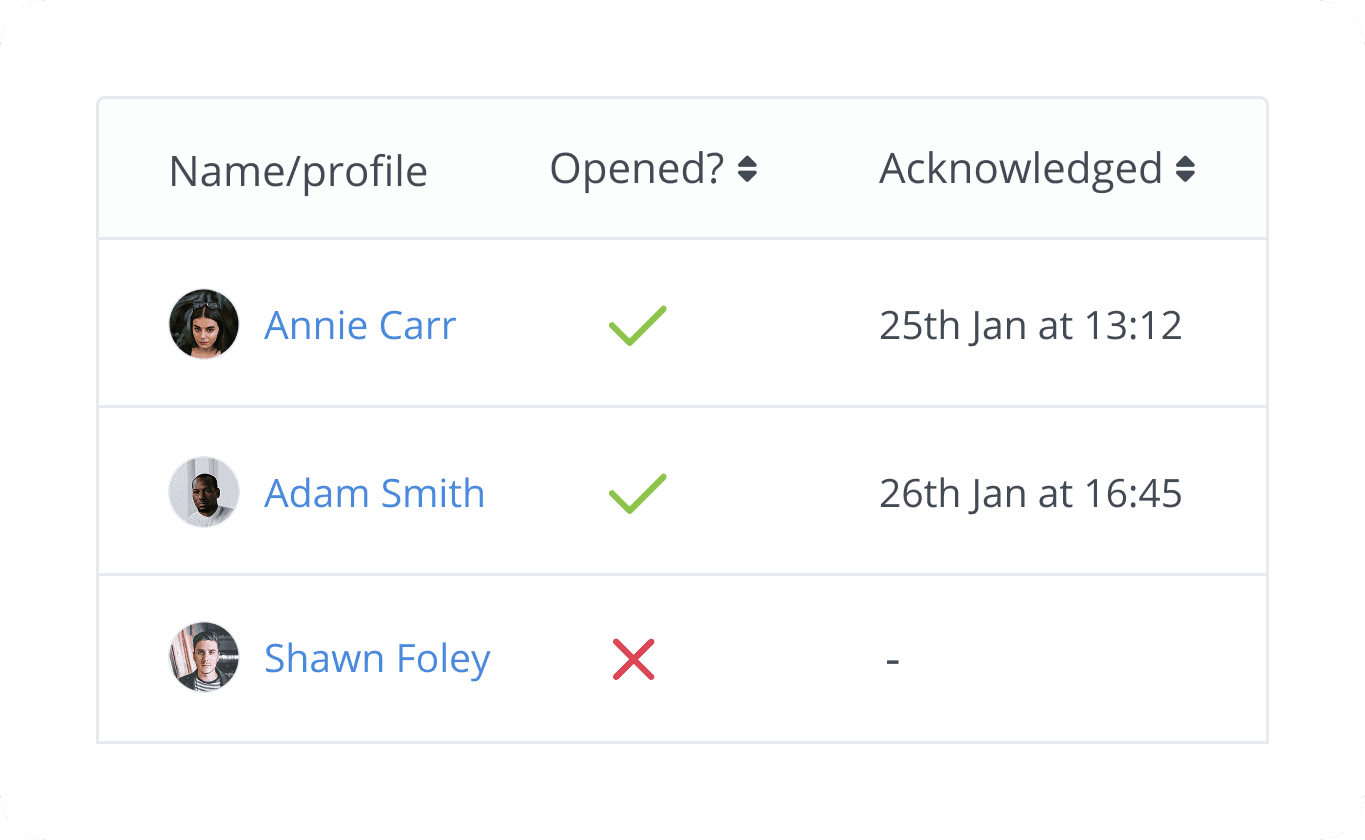
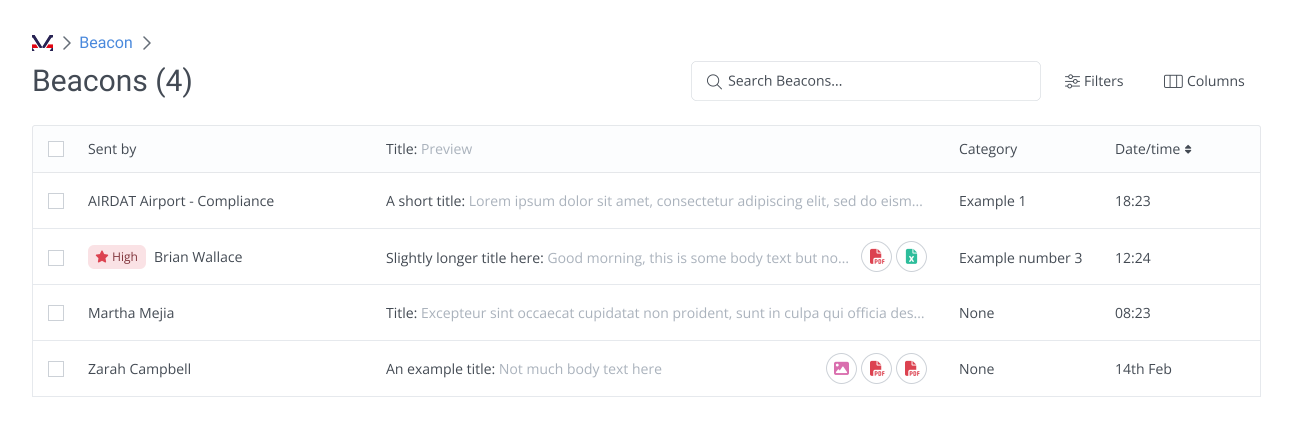
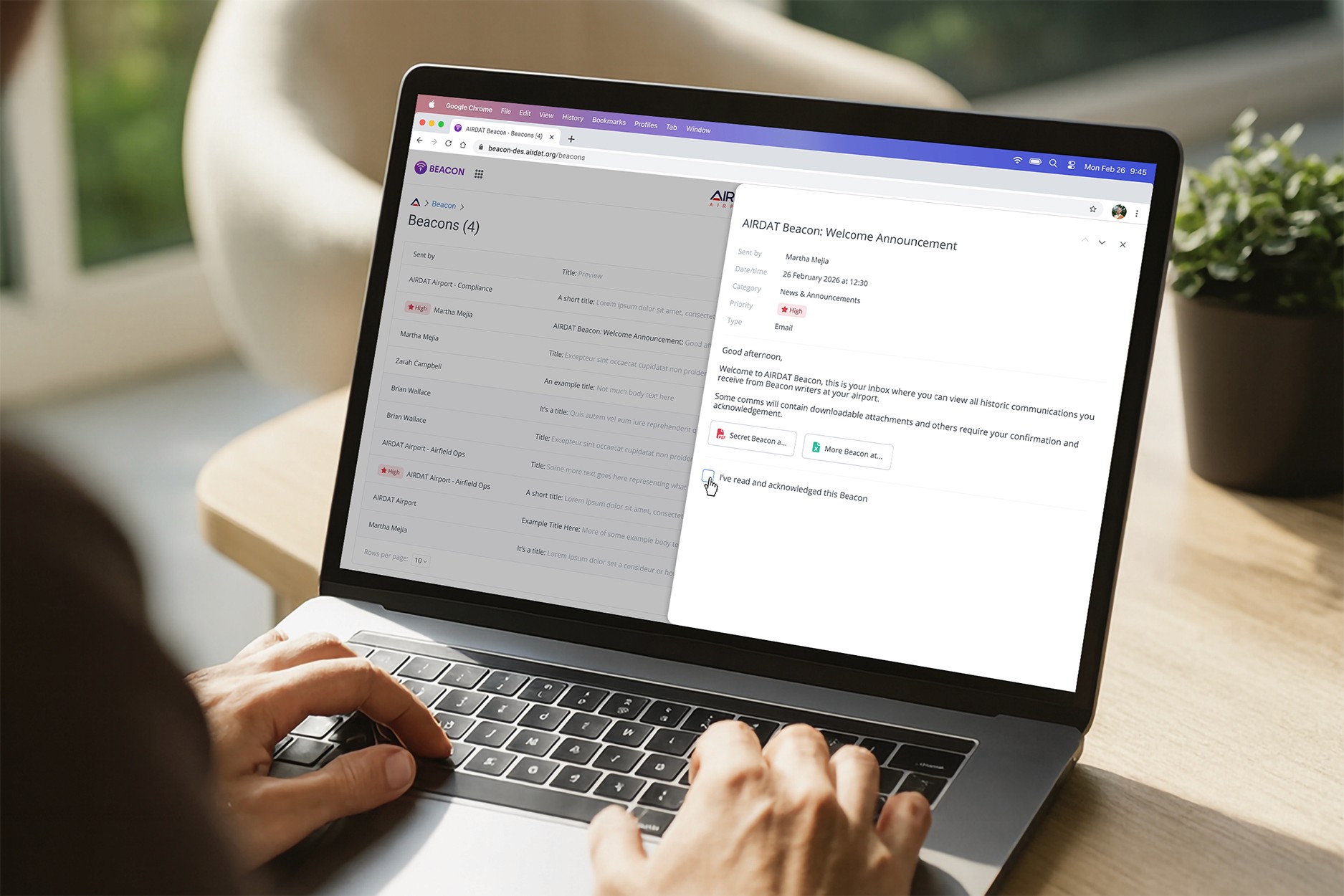
Every message sent through Beacon is recorded in one persistent system, giving staff a clear history of communications they’ve received. Open tracking and an optional acknowledgement requirement provide visibility for authors and remove ambiguity around whether critical updates have been seen and understood.

A Single Source of Truth
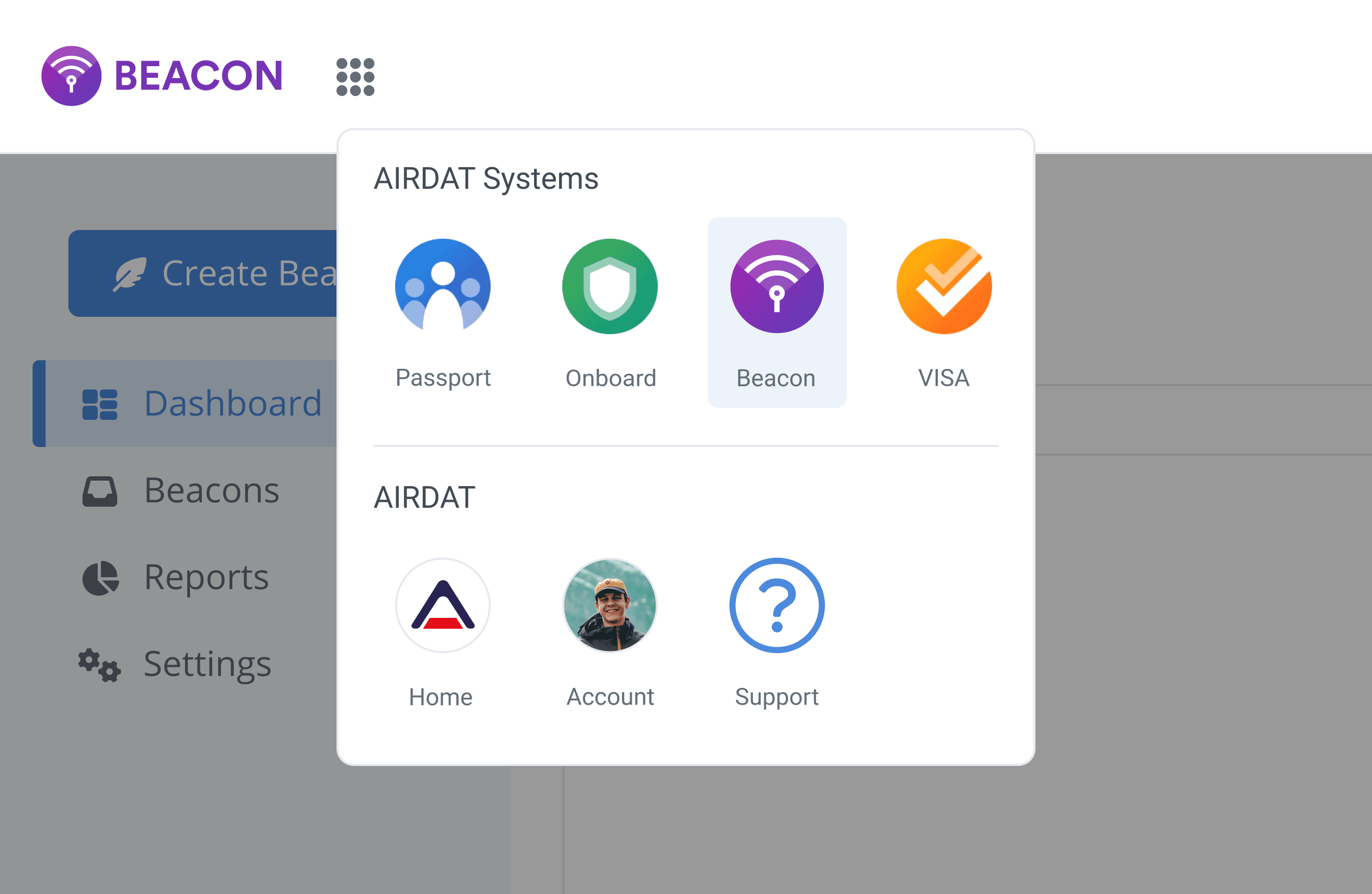
Beacon replaces fragmented communication channels with one trusted platform. Staff no longer need to rely on noticeboards, emails, or shared folders, all operational communications are accessible in one consistent, reliable place.
The solution
From Fragmentation to Precision and Accountability
Beacon was designed as a centralised, role-aware communications platform within the AIRDAT suite. By building on a single AIRDAT account and its existing user data, including company, job role, and permissions, Beacon enables airport operations teams to communicate with precision, confidence, and clarity.
Targeted Comms
Using live data from AIRDAT, writers can build an audience which targets recipients by company, job role, and permission. This removes ineffective general broadcasts and ensures operational updates reach only the relevant people.
Accountability and Visibility
Every message sent through Beacon is recorded in one persistent system, giving staff a clear history of communications they’ve received. Open tracking and an optional acknowledgement requirement provide visibility for authors and remove ambiguity around whether critical updates have been seen and understood.
A Single Source of Truth
Beacon replaces fragmented communication channels with one trusted platform. Staff no longer need to rely on noticeboards, emails, or shared folders, all operational communications are accessible in one consistent, reliable place.

THE SHOWCASE
Bringing Beacon to Life
THE SHOWCASE
Bringing Beacon to Life
The RESEARCH
Research and Discovery
Beacon was originally conceived prior to my time at AIRDAT but paused due to the financial impact of COVID on the aviation industry. When it resurfaced on the roadmap, the operational landscape had shifted significantly. Rather than proceeding with the original feature assumptions, I advocated for a structured discovery phase to reassess the problem space before committing engineering resource.
Formal UX research was not standard practice within the company at the time. Introducing this phase represented a shift from assumption-led feature delivery to evidence-led product definition.
Given tight time and budget constraints, I proposed a lean qualitative approach focused on targeted interviews within our existing airport network.
User Interviews
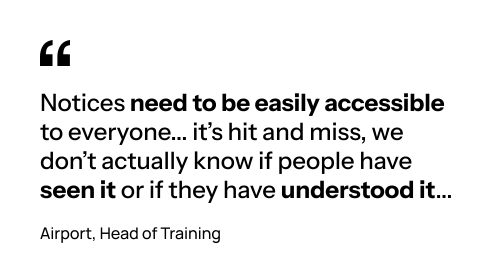
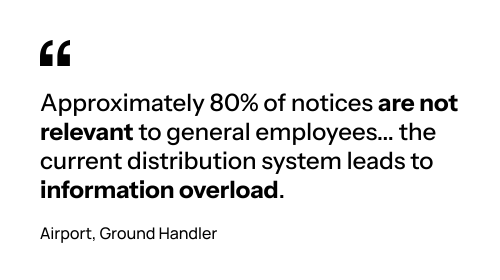
I proposed five semi-structured interviews across two major UK airports and one Australian airport. Participants worked in operations, ground handling, training, and compliance, all with direct airside experience.
Interviews were recorded (with permission), and AI-assisted transcription was used to summarise key topics and quotes from participants.
Across interviews, four systemic communication failures consistently emerged:
Lack of accountability
Inability to accurately target communications
No reliable communication archive
Fragmented, non-consolidated systems
This allowed us to define what Beacon must solve at launch, and more importantly what it should not.
Personas & Problem Framing
I synthesised findings into four behaviour-based personas representing distinct usage patterns, from low-frequency message recipients to high-frequency operational authors. Each persona was directly mapped to validated pain points and value propositions, ensuring coverage without expanding scope.
Research revealed the original feature vision was too broad. By grounding decisions in validated behaviours, we deliberately reduced scope and focused the MVP on:
Role-based targeting
Message visibility tracking
Centralised communication history
Non-essential features were deprioritised to protect focus and reduce build risk.
MVP & Validation Strategy
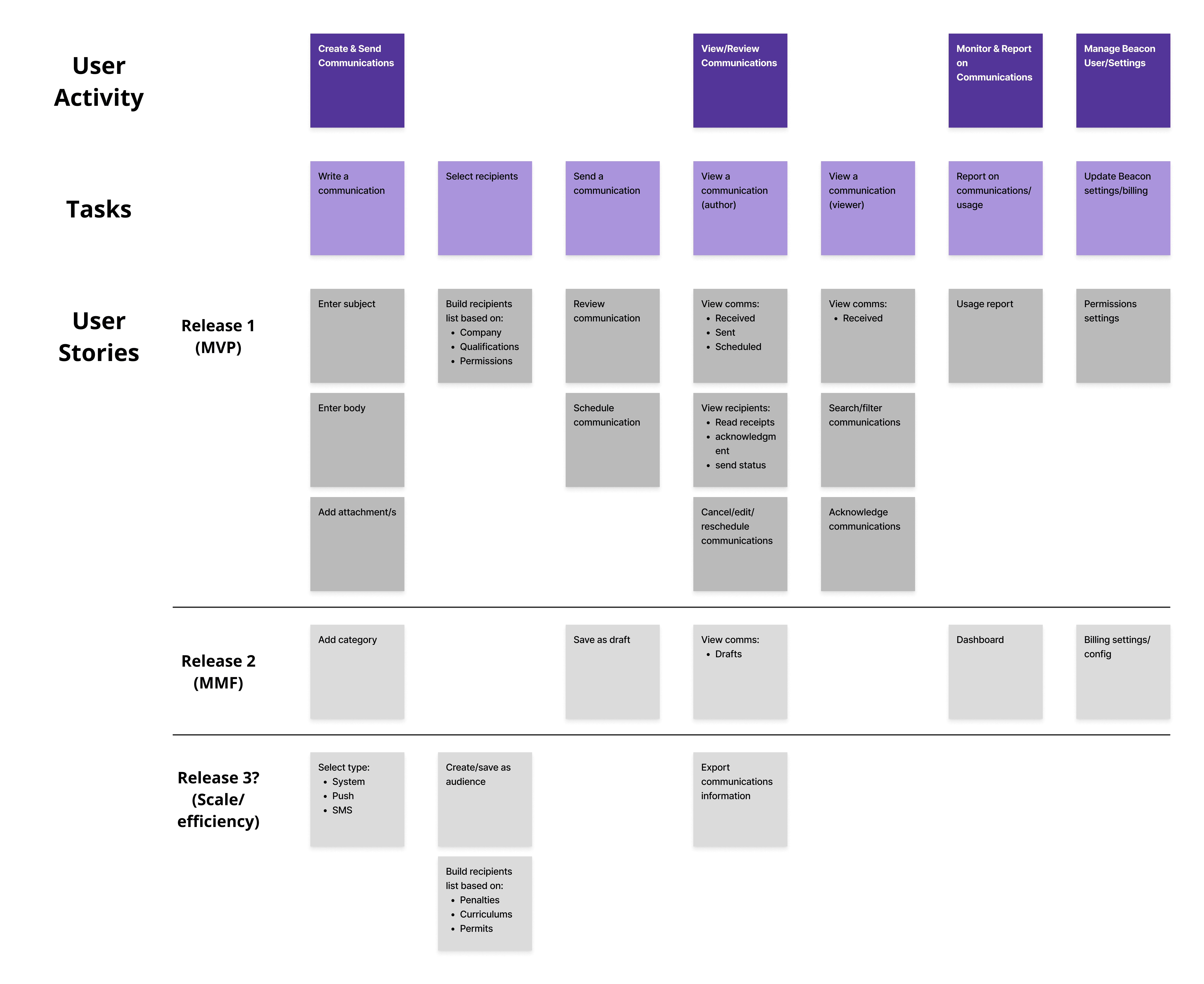
Working closely with the Product Owner and engineering team, we translated research into epics during a structured story-writing workshop.
Beacon was intentionally defined as an MVP-first release to reduce delivery risk and validate behavioural assumptions before scaling investment. Rather than launching broadly, we planned to structure a controlled beta with selected airport partners to test core accountability workflows in real operational environments.
Validation will focus on:
Adoption patterns across role types
Message creation and acknowledgement behaviour
Friction points within key flows
Structured stakeholder feedback
Insights from analytics and user feedback will inform iteration toward a defined MMF, ensuring development is driven by real usage rather than internal assumption.
Development is currently in progress, with early-stage airport partners confirmed for testing.
The RESEARCH
Research and Discovery
Beacon was originally conceived prior to my time at AIRDAT but paused due to the financial impact of COVID on the aviation industry. When it resurfaced on the roadmap, the operational landscape had shifted significantly. Rather than proceeding with the original feature assumptions, I advocated for a structured discovery phase to reassess the problem space before committing engineering resource.
Formal UX research was not standard practice within the company at the time. Introducing this phase represented a shift from assumption-led feature delivery to evidence-led product definition.
Given tight time and budget constraints, I proposed a lean qualitative approach focused on targeted interviews within our existing airport network.
User Interviews
I proposed five semi-structured interviews across two major UK airports and one Australian airport. Participants worked in operations, ground handling, training, and compliance, all with direct airside experience.
Interviews were recorded (with permission), and AI-assisted transcription was used to summarise key topics and quotes from participants.
Across interviews, four systemic communication failures consistently emerged:
Lack of accountability
Inability to accurately target communications
No reliable communication archive
Fragmented, non-consolidated systems
This allowed us to define what Beacon must solve at launch, and more importantly what it should not.
Personas & Problem Framing
I synthesised findings into four behaviour-based personas representing distinct usage patterns, from low-frequency message recipients to high-frequency operational authors. Each persona was directly mapped to validated pain points and value propositions, ensuring coverage without expanding scope.
Research revealed the original feature vision was too broad. By grounding decisions in validated behaviours, we deliberately reduced scope and focused the MVP on:
Role-based targeting
Message visibility tracking
Centralised communication history
Non-essential features were deprioritised to protect focus and reduce build risk.
MVP & Validation Strategy
Working closely with the Product Owner and engineering team, we translated research into epics during a structured story-writing workshop.
Beacon was intentionally defined as an MVP-first release to reduce delivery risk and validate behavioural assumptions before scaling investment. Rather than launching broadly, we planned to structure a controlled beta with selected airport partners to test core accountability workflows in real operational environments.
Validation will focus on:
Adoption patterns across role types
Message creation and acknowledgement behaviour
Friction points within key flows
Structured stakeholder feedback
Insights from analytics and user feedback will inform iteration toward a defined MMF, ensuring development is driven by real usage rather than internal assumption.
Development is currently in progress, with early-stage airport partners confirmed for testing.
More Work
You Might Like
More Work
You Might Like
More Work
You Might Like
More Work
You Might Like
More Work
You Might Like
More Work
You Might Like